
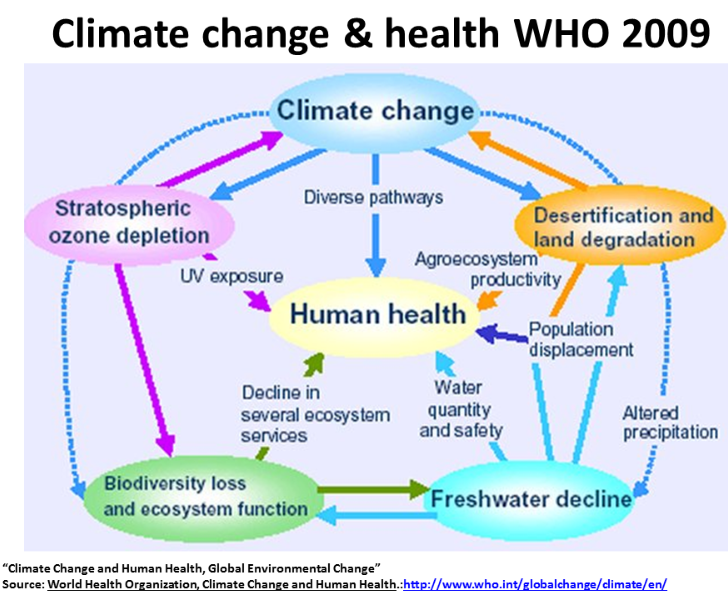
Health
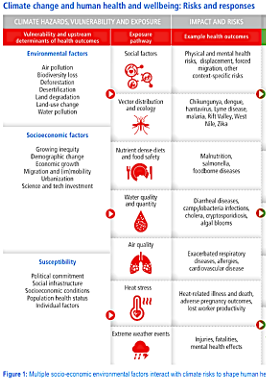
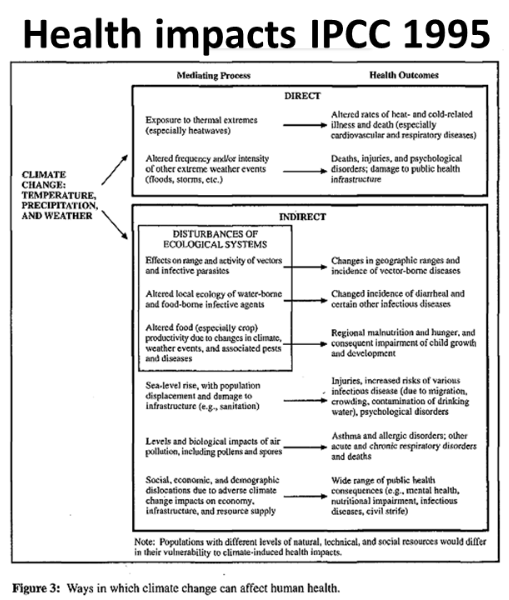
The health effects of global warming and climate change have been
well known for decades as the 1995 IPCC chart shows.
The populations in Africa and lower latitude regions have always
been recognized as most vulnerable to all these impacts.
Extreme weather events that are already increasing from global climate change, are the most damaging to human life and health.
The most climate vulnerable regions are already suffering negative effects on crop yields (IPCC 2014 AR5).
Water and food security
Increasing adverse impacts are affecting water security, with climate change increasing both droughts and floods, even rivers and large have dried up.
Food Production
The long-standing great increase in food production is now being cut back by increasing extreme weather events (IPCC AR6)
well known for decades as the 1995 IPCC chart shows.
The populations in Africa and lower latitude regions have always
been recognized as most vulnerable to all these impacts.
Extreme weather events that are already increasing from global climate change, are the most damaging to human life and health.
The most climate vulnerable regions are already suffering negative effects on crop yields (IPCC 2014 AR5).
Water and food security
Increasing adverse impacts are affecting water security, with climate change increasing both droughts and floods, even rivers and large have dried up.
Food Production
The long-standing great increase in food production is now being cut back by increasing extreme weather events (IPCC AR6)
Climate Emergency Institute
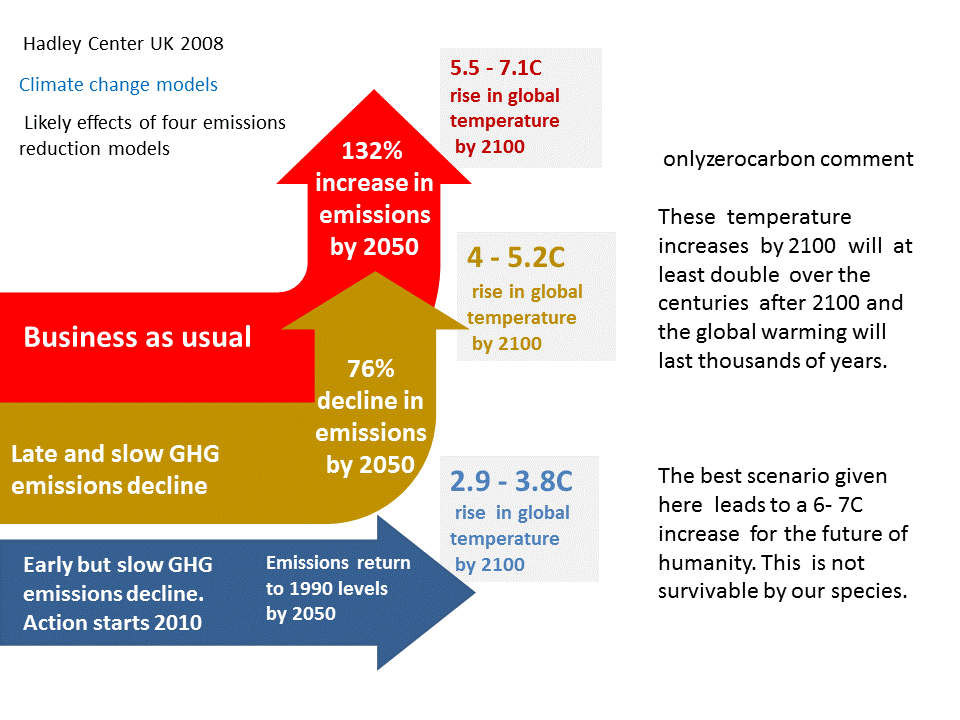
Small children are most vulnerable to all climate change health impacts.
2017 Paper Pollution from Fossil-Fuel Combustion is the Leading Environmental Threat to Global Pediatric Health
2017 Paper Pollution from Fossil-Fuel Combustion is the Leading Environmental Threat to Global Pediatric Health
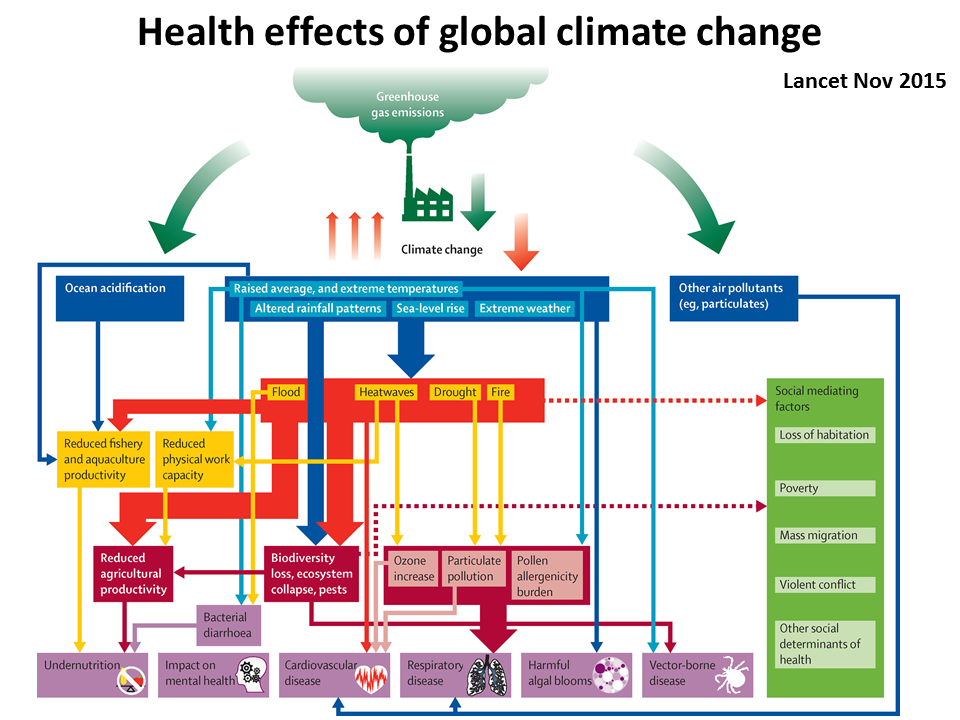
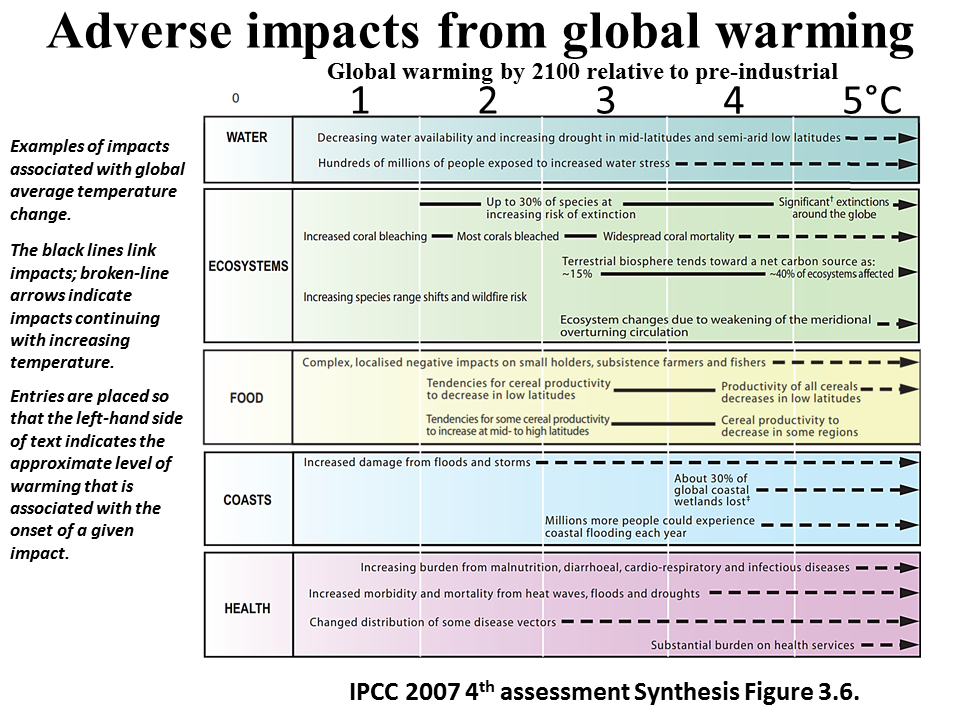
Extreme weather events increased by global climate change are the most damaging of impact categories to human health and crop production.
Environmental health risk assessment of total pollution health impacts by all SOURCES Climate change should be assessed by an environmental health risk assessment, not only by a climate change assessment. The IPCC refers to risk but does not in fact apply risk to the assessments.
Industrial energy pollution
As is well known Fossil fuel energy production causes deadly health impacts from air pollution as well as from climate change. While deaths from global climate change are estimated in the hundreds of thousands, deaths from taxic fossil fuel air pollution are estimated at 8-10 million a year.
Global climate change increases air pollution, so as global climate change increases so will the millions of deaths. Gasoline combustion by vehicle exhausts increases the risk of cancers, particularly affecting children. Coal in particular increases the risk of cancers and also emits mercury which is a neurological toxin.
Fossil fuel air pollution is a cause that increases the risk of respiratory disease, cardiovascular disease, cancers, neurological disease, diabetes, and adverse outcomes of pregnancy.
Industrial age food production pollution
A large source of methane emissions is the livestock meat industry. Methane is exhaled by ruminant digestion. Meat is also a large the cause of human disease. Meat increases the risk of cardiovascular disease, colorectal cancer and type 2 diabetes.
Industrial energy pollution
As is well known Fossil fuel energy production causes deadly health impacts from air pollution as well as from climate change. While deaths from global climate change are estimated in the hundreds of thousands, deaths from taxic fossil fuel air pollution are estimated at 8-10 million a year.
Global climate change increases air pollution, so as global climate change increases so will the millions of deaths. Gasoline combustion by vehicle exhausts increases the risk of cancers, particularly affecting children. Coal in particular increases the risk of cancers and also emits mercury which is a neurological toxin.
Fossil fuel air pollution is a cause that increases the risk of respiratory disease, cardiovascular disease, cancers, neurological disease, diabetes, and adverse outcomes of pregnancy.
Industrial age food production pollution
A large source of methane emissions is the livestock meat industry. Methane is exhaled by ruminant digestion. Meat is also a large the cause of human disease. Meat increases the risk of cardiovascular disease, colorectal cancer and type 2 diabetes.
Dr. P. Carter Paper Climate Impacts Responses Environmental Health Risk Assessment to Correct Climate Change Policy-making Failure, Int. Conference on Climate Change:Impacts & Responses.
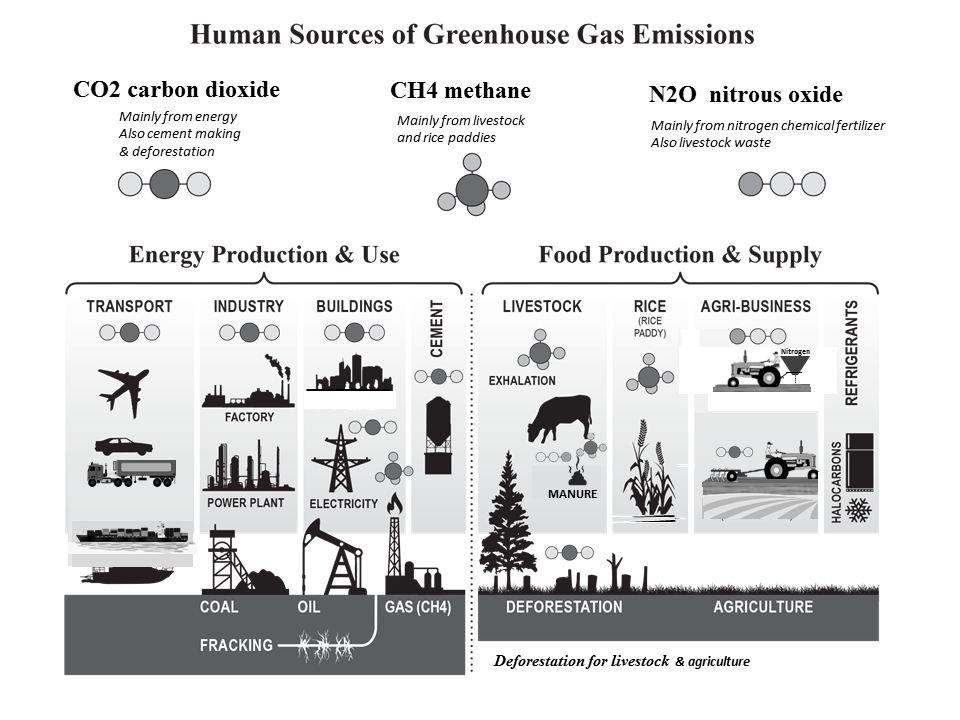
Greenhouse gas emissions can be conveniently be broadly divided into two large sources. The main one is carbon combustion for energy. The other, not far behind it when including deforestation for the livestock to meat industry, is food production.
Increasingly the research is showing that the two big factors in the chronic degenerative diseases of the industrially developed world are fossil fuel air pollution and are less than healthy diets.
Increasingly the research is showing that the two big factors in the chronic degenerative diseases of the industrially developed world are fossil fuel air pollution and are less than healthy diets.
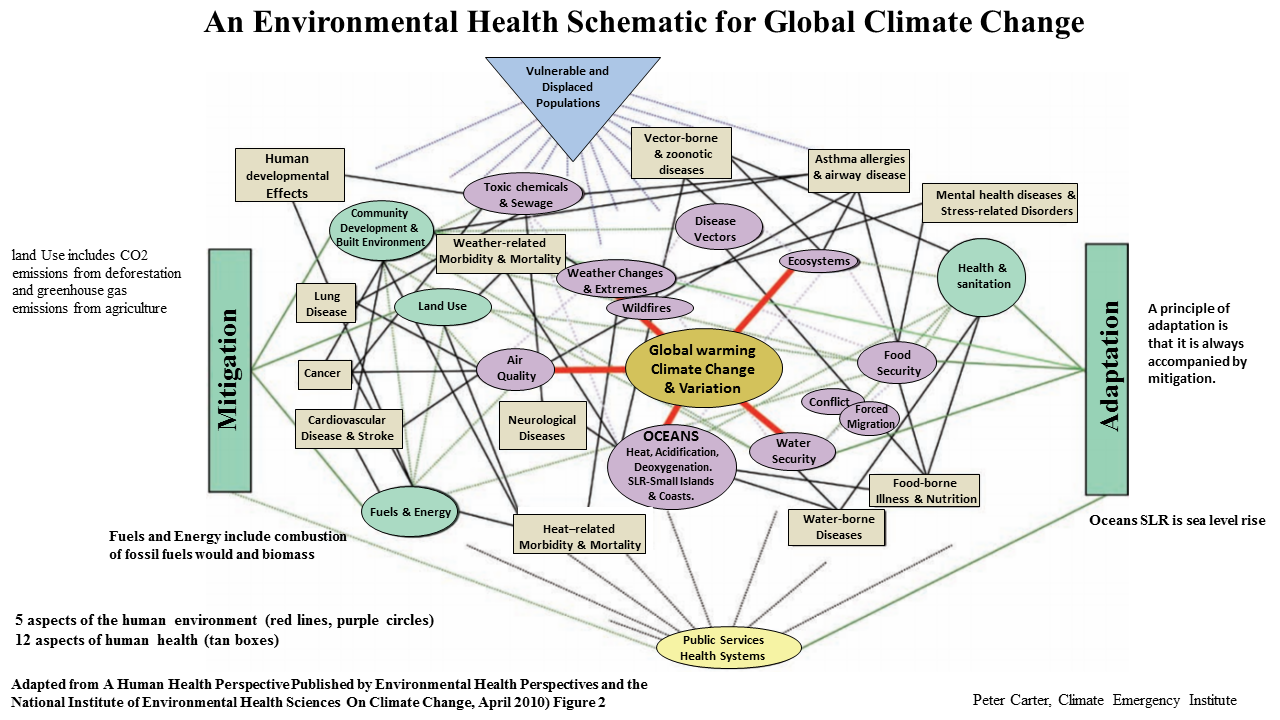
The impacts of global climate change on human health comes under the discipline of environmental health risk assessment and management.
This differs from the IPCC and other climate change assessments in that the pollutants from all the sources of the greenhouse gas emissions are included.
From the environmental health perspective by far the greatest damaging human health impact is from fossil fuel air pollution, which the research says will be increased by global warming.
Fossil Fuel Air Pollution
The two main sources of air pollution's damaging effects on human health are ground level surface ozone and particulate matter.
Surface ozone is produced as a chemical reaction from fossil fuel air pollutants catalyzed by solar warmth. Therefore surface ozone increases with global warming.
It is highly irritant to the respiratory tract. The research is showing that surface warming and air circulation effects will increase the adverse effects from particulate matter.
“Ground level ozone is formed through photochemical reactions that involve nitrogen oxides (NOx), carbon monoxide (CO), methane (CH4), and volatile organic compounds (VOCs) in the presence of sunlight and elevated temperatures. Therefore as temperatures rise, many air pollution models project increased ozone production, especially within and surrounding urban areas. It is highly irritant to the entire respiratory tract. "There is observed evidence that tropospheric ozone increases in extreme heat, resulting in air pollution mortality” (IPCC 2014, 728-729).
There is evidence that global warming and climate change will increase the adverse impacts of air pollution pollutants in general. (Future global mortality from changes in air pollution attributable to climate change, Raquel A. Silva 2017 https://www.nature.com/articles/nclimate3354) (2014 above Impact on human health of climate changes Massimo Franchini) (Occurrence and persistence of future atmospheric stagnation events Daniel E. Horton https://www.nature.com/articles/nclimate2272)
This differs from the IPCC and other climate change assessments in that the pollutants from all the sources of the greenhouse gas emissions are included.
From the environmental health perspective by far the greatest damaging human health impact is from fossil fuel air pollution, which the research says will be increased by global warming.
Fossil Fuel Air Pollution
The two main sources of air pollution's damaging effects on human health are ground level surface ozone and particulate matter.
Surface ozone is produced as a chemical reaction from fossil fuel air pollutants catalyzed by solar warmth. Therefore surface ozone increases with global warming.
It is highly irritant to the respiratory tract. The research is showing that surface warming and air circulation effects will increase the adverse effects from particulate matter.
“Ground level ozone is formed through photochemical reactions that involve nitrogen oxides (NOx), carbon monoxide (CO), methane (CH4), and volatile organic compounds (VOCs) in the presence of sunlight and elevated temperatures. Therefore as temperatures rise, many air pollution models project increased ozone production, especially within and surrounding urban areas. It is highly irritant to the entire respiratory tract. "There is observed evidence that tropospheric ozone increases in extreme heat, resulting in air pollution mortality” (IPCC 2014, 728-729).
There is evidence that global warming and climate change will increase the adverse impacts of air pollution pollutants in general. (Future global mortality from changes in air pollution attributable to climate change, Raquel A. Silva 2017 https://www.nature.com/articles/nclimate3354) (2014 above Impact on human health of climate changes Massimo Franchini) (Occurrence and persistence of future atmospheric stagnation events Daniel E. Horton https://www.nature.com/articles/nclimate2272)
2019 VIDEO Planetary Health: The Future is Now
WHO 2019 Top health threats are air pollution and climate change
8 March 2021 research
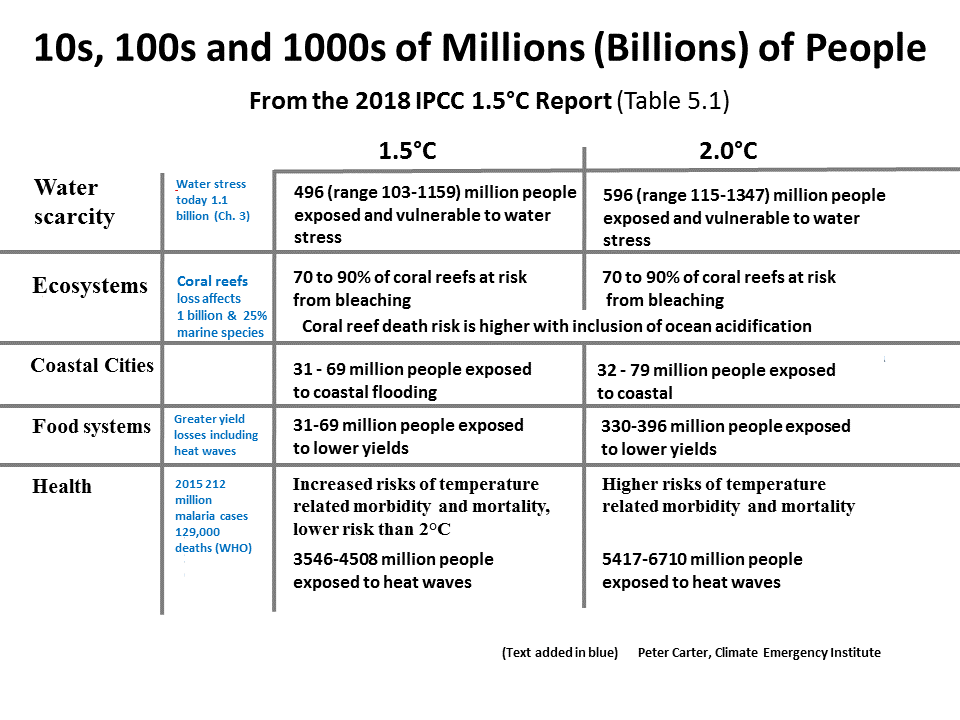
Keep warming under 1.5°C to stop tropics becoming too hot for people to live
8 May 2020. Many regions already over being impacted by highly dangerous levels of heat and humidity
Keep warming under 1.5°C to stop tropics becoming too hot for people to live
8 May 2020. Many regions already over being impacted by highly dangerous levels of heat and humidity

6 Sept 2021. 200 health journals call world leaders to address 'catastrophic harm to health' from climate change
April 2021. Fossil fuel air pollution kills 10 million/year
May 2022 Inter-academy Health in the Climate Emergency: A global perspective
IPCC AR6 Fact Sheet Health
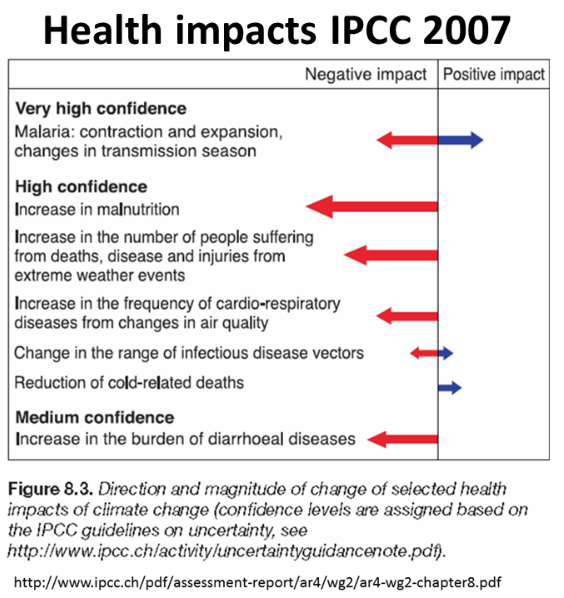
IPCC 2007 AR4 was particularly good on health
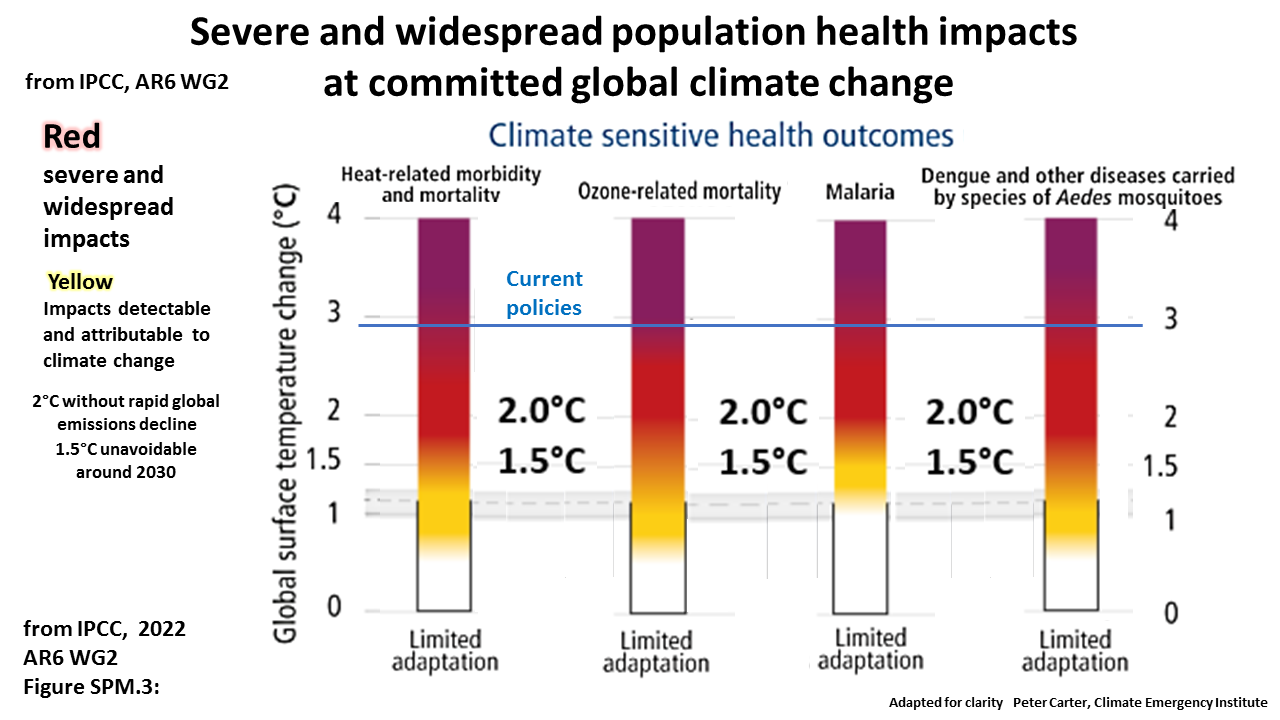
IPCC AR6 WG2, SPM
o Climate change has adversely affected the health of people globally.
o Climate change has adversely affected the health of people globally.
o In all regions extreme heat events have resulted in human mortality and morbidity.
o Climate-related food-borne and water-borne diseases has increased.
o The incidence of vector-borne diseases has increased
o Animal and human diseases, including zoonoses, are emerging in new areas.
o Water and food-borne disease risks have increased
o Increased rain and flooding have increased of diarrheal diseases, including cholera
o Increased exposure to wildfire smoke - with cardiovascular and respiratory distress.
o The incidence of vector-borne diseases has increased
o Animal and human diseases, including zoonoses, are emerging in new areas.
o Water and food-borne disease risks have increased
o Increased rain and flooding have increased of diarrheal diseases, including cholera
o Increased exposure to wildfire smoke - with cardiovascular and respiratory distress.
o Health services have been disrupted by extreme events such as floods.